
Cultural Audit and Map Case Study
Using the data to research hard cultural infrastructure in the city
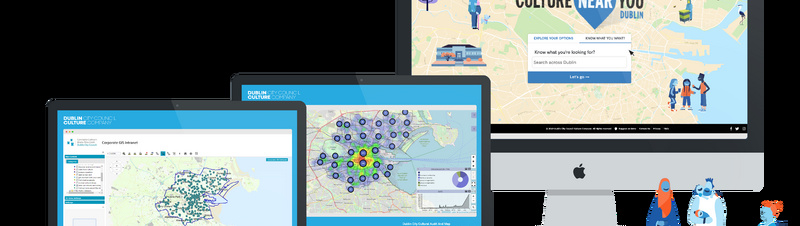
The Dublin City Cultural Audit and Map is an audit, map and a dynamic database with cultural information about the city. Information on the map includes: arts and heritage, parks and nature, sport and fitness, food, hobbies, community involvement and education, as well as artists and makers who call Dublin home.
The map can be accessed by all City Council staff (via GIS) and the data can be overlaid with CSO data by planners and decision-makers to provide opportunity for analysis via the Feature Analyser function. It is also available to the public via a website called Culture Near You.
This live database will continue to grow and evolve, organising information and tracking changes in the cultural landscape of the city. It was made by Dublin City Council Culture Company in partnership with Dublin City Council to deliver Priority 2(4) and 3(1) of the Dublin City Cultural Strategy (2016-2021).
Earlier this year, Dublin City Council Culture Company and Dublin City Council shared the Dublin City Cultural Audit and Map data with Turley (UK and Ireland Planning and Development Consultancy). Turley, along with OBFA Architects were commissioned by Dublin City Council to carry out research into the cultural infrastructure of the city. Their first port of call was the Dublin City Cultural Audit and Map and their research resulting from this will feed directly into the Dublin City Development Plan 2022 - 2028.
We sat down with John Davison, Director, Strategic Communications at Turley to find out more about how data from the Dublin City Cultural Audit and Map impacted their research.
John began by giving us an overview of the project.
“The work we're doing at the moment is a research study in the cultural sector, looking specifically at what we've termed ‘hard infrastructure’, so looking at the buildings and institutional fabric that exists across Dublin to enable the arts and cultural sector to undertake their work.”
Turley began by benchmarking Dublin against other cities by the priorities outlined in the Agenda 21 for culture, which is the first worldwide document establishing an undertaking by cities and local governments for cultural development. The fact that Dublin has mapped cultural assets through the Dublin City Cultural Audit and Map project was already seen as a huge plus for cultural development in the city.
John talked about why this project and cultural mapping is considered so important.
“Having that data allows the city to make choices in a considered way, in dialogue with the sector and developers ... This actually gives some control and insight to the planning authority to the, to one of the principal funders in the city of arts and culture as to how it uses its resources. And I think that's really useful and really powerful. When we benchmarked other cities, so many cities still don't have that.”
“We came to you [the Culture Company] at the beginning, because we knew it would be difficult to make meaningful recommendations and meaningful discourse in the reports about where cultural infrastructure needs to be and what it's contribution is to regeneration and the night time economy without actually having it spatially outlined.”
Role of culture in the city development
The research undertaken by Turley is being compiled into a report with recommendations, which will inform the draft City Development Plan 2022 - 2028.
“Our work is really looking at the role of culture in the development of the city and specifically, the use of the mapping data from the Dublin City Cultural Audit and Map was to look at the spatial relationship of how culture is spread out across the city and essentially look for the pattern of where infrastructure fits - particularly that hard structure, but also the softer, and essentially, so that it can guide development in the future and policy in the future as to where and what forms of cultural infrastructure are required in the city.”
Identifying cultural gaps
We asked John what was learned from the Dublin City Cultural Audit and Map data.
“Quite a lot. I suppose the obvious thing was that there's an uneven distribution of infrastructure across the city. I think probably one of the most compelling things is that the classification of infrastructure, whether it's community halls or purpose built venues, needs to be further defined.
There's a huge amount of data in the Cultural Audit that identifies that where culture happens in the city is very well dispersed, but actually, where the purpose-built infrastructure is. It’s very centrally located along the core of the city, particularly along with the banks of the Liffey and sort of extends running north and south, with the LUAS as well - it really followed the LUAS across the city.
And that's good - it’s important that central infrastructure has been linked to public transport [and for other] key findings as well, it's close to the institutional organisations like universities [for example], but what it also illustrates is that while there is a wide dispersion of community assets, the idea of artform specific or a purpose-built, or purpose- specific venues is, once you get out of the core of the city centre, it becomes harder to access.”
Developing hard cultural infrastructure
“The primary benefit of having the mapping has been able to illustrate some of the areas where cultural infrastructure has not been developed - really hard infrastructure, and what the mapping data showed was the distribution of cultural space across the city..
There is not an area of the city where it doesn't have a library or a community space or a cultural organisation and that’s really encouraging as part of the unique ecology of Dublin's cultural sector. A lot of that is community led, ground up, artist led, sector led, and that's great.”
An example of “Exploring artforms with the Cultural Audit data”
John indicated how combining the Cultural Audit Data with the 13 artforms as defined by the Arts Council in 2013 was particularly powerful.
“We used the cultural mapping data, and essentially overlayed the 2013 Arts Act artform categories to that data, and looked at what the distribution of artform infrastructure was. I think that's the first time that's been done in the city and it’s quite important, because it allows you to ascertain, if you want to develop, for instance, a black box theater space, [you can look at] where is the existing provision for theater and performing arts in the city because there'll be gaps.
“You can make choices as to whether you deliver something into a gap, or you start to cluster things around existing infrastructure and that's a choice. But [the mapping] allows you to analyse, and I think, importantly, to consider what policies enable that development in the future.”
Cultural workspaces
Another point of interest that emerged in the study was the difference between infrastructure that was designed for the public to consume culture, versus cultural workspace infrastructure which John believes can play a large role in regeneration and making the city a culturally active space.
“How the Cultural Audit and Map data informed this was to look at actually just the fact that whilst there is a very high level of dispersion of access to culture, to community venues and libraries, there is probably less available workspace infrastructure distributed across the city.
Going forward, [there’s] a need to look at how, particularly policies around new developments, encourage the right kind of cultural building, but also where it's built, and to ensure that it actually is in parts of the city where artists live.”
Next steps
John believes there is potential for the Dublin City Cultural Audit and Map data to become more useful over time as it begins to track changes in the city. Having this data in place empowers planners to make considered choices.
“What our report has done is create a baseline of information that I think would be really interesting to see how successful this Development Plan is in changing that pattern in positive ways. It means that the Council can start to make meaningful measurements of their objectives.”
The Dublin City Cultural Audit and Map is designed to be a living resource, which is constantly updated and evolving alongside the city. This approach is deemed useful for future research and development projects such as this in-depth look at cultural infrastructure in the city.
“In terms of data, the fact that it's there, the fact that it's captured, and the fact that it continues to be updated is a huge resource.”
About the Dublin City Cultural Audit and Map
The Cultural Audit and Map adds to Dublin City Council’s knowledge base to inform decisions by the city council departments, planners and strategists.
Cultural information about the city on the map includes: arts and heritage, parks and nature, sport and fitness, food, hobbies, community involvement and education, as well as artists and makers who call Dublin home.
This intelligence project is also a public resource, a website called Culture Near You, that makes the city’s cultural buildings, organisations and networks easier to find and connect with.
The Cultural Map and Audit works within the existing mapping and Geographical Information Systems (GIS) of Dublin City Council. It was developed using a ‘cultural mapping’ process and the public are invited to add to and update this data via Culture Near You.
This dynamic database will continue to grow and evolve, organising information and tracking changes in the cultural landscape of the city.
Made by Dublin City Council Culture Company in partnership with Dublin City Council to deliver Priority 2(4) and 3(1) of the Dublin City Cultural Strategy (2016-2021).